
Description
Prevalent Articulating Paper- Hydrophilic Articulating Paper
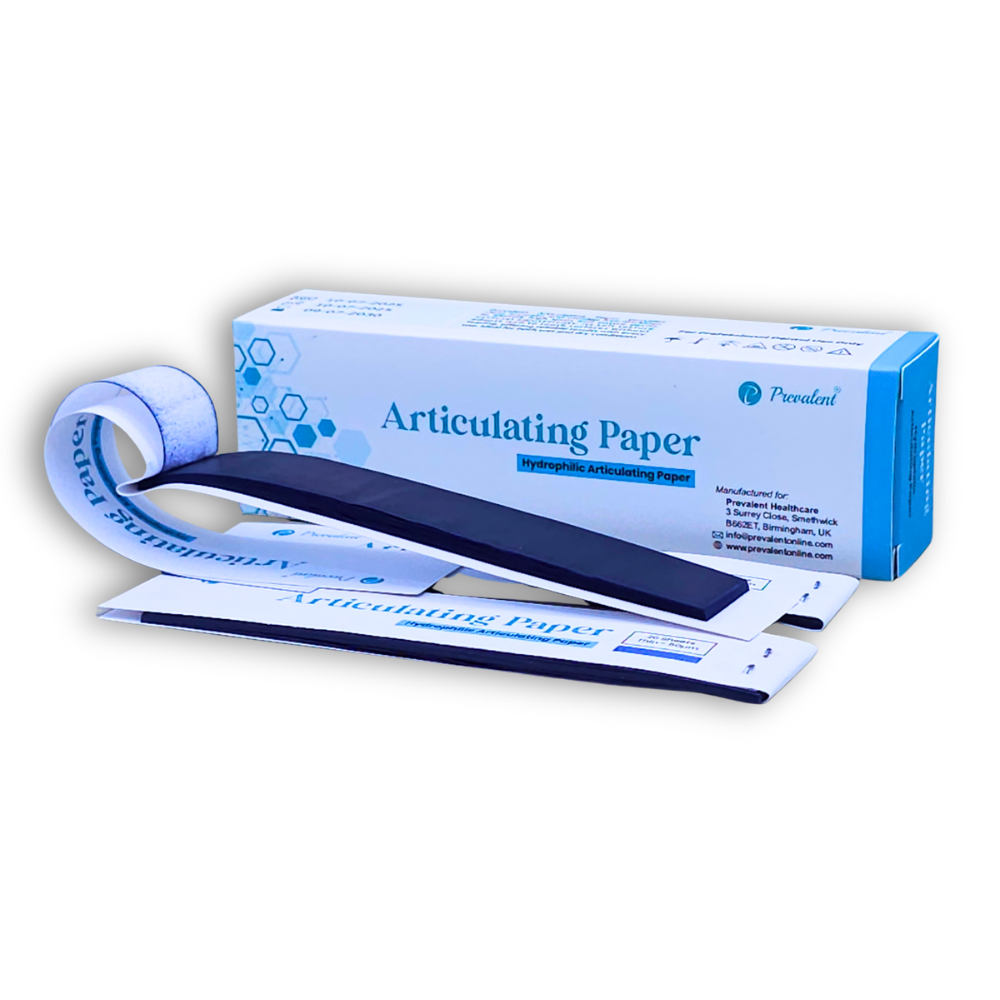
Prevalent Hydrophilic Articulating Paper helps dental professionals identify occlusal contacts, high spots and bite interferences with clarity and consistency. Its hydrophilic properties support reliable marking even when moisture is present on the tooth surface.
In addition, the flexible paper adapts easily to different tooth surfaces. It produces clear contact markings and helps dentists evaluate occlusion during restorative, prosthodontic and orthodontic procedures. Therefore, it provides a practical solution for routine occlusal assessment and adjustment.
Clinical Applications
- Occlusal contact detection – Helps dentists identify contact points between opposing teeth during bite assessment.
- Restorative adjustments – Supports the detection of high spots and occlusal interferences in crowns, bridges and fillings.
- Prosthodontic procedures – Helps evaluate occlusal contacts during denture, crown and bridge adjustments.
- Orthodontic assessment – Supports bite evaluation during orthodontic treatment and occlusal adjustments.
- Occlusal fine-tuning – Helps dentists monitor contact points and make precise adjustments for balanced occlusion.
Key Features
- Hydrophilic performance – Provides reliable contact markings even on moist tooth surfaces.
- Two thickness options – Available in Thin 50 μm and Thick 100 μm versions for different clinical requirements.
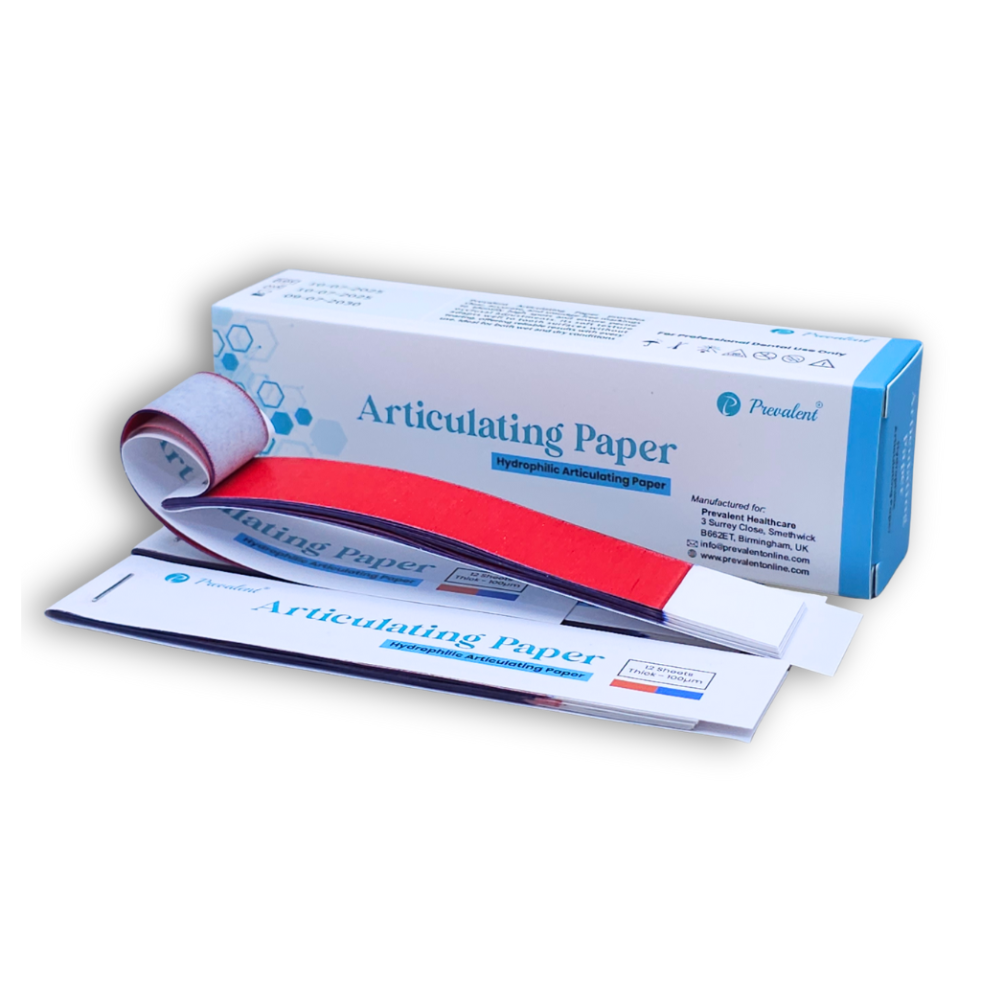
- Multiple color options – Choose from Blue, Red and Dual-Tone Red/Blue for easy visualization.
- Flexible and durable – The paper offers excellent flexibility while resisting tearing and smudging during clinical use.
- Clear contact markings – Produces distinct and consistent markings to help dentists identify occlusal contact points accurately.
Why Choose Prevalent Hydrophilic Articulating Paper?
- Reliable Marking in Moist Conditions – Moisture can make conventional articulating papers difficult to use. However, the hydrophilic properties of Prevalent Articulating Paper support clear markings even when moisture is present.
- Choice of Two Thicknesses– Dentists can choose between 50 μm thin paper and 100 μm thick paper. Therefore, they can select the appropriate option according to the clinical procedure and marking requirement.
- Three Color Options– Prevalent offers Blue, Red and Red/Blue options. As a result, dentists can easily select a color that provides good visibility for a particular procedure.
- Clear and Consistent Contact Points– The paper transfers color clearly onto contact areas. Consequently, dentists can identify high spots, occlusal contacts and interferences more easily.
- Versatile Clinical Application– Dentists can use Prevalent Articulating Paper during restorative, prosthodontic and orthodontic procedures. In addition, it supports routine bite assessment and occlusal adjustment.
Frequently Asked Questions
1. What is Prevalent Hydrophilic Articulating Paper?
Prevalent Hydrophilic Articulating Paper is a dental diagnostic paper that helps dentists identify occlusal contacts, high spots and bite interferences. Moreover, its hydrophilic properties support reliable marking in moist conditions.
2. What is articulating paper used for?
Dentists use articulating paper to identify contact points between opposing teeth. Therefore, it helps them locate high spots and evaluate the patient’s occlusion.
3. What thicknesses are available?
Prevalent Articulating Paper comes in 50 μm Thin and 100 μm Thick options. Therefore, dentists can choose the thickness that best suits their clinical requirements.
4. Which colors are available?
The product comes in Blue, Red and Dual-Tone Red/Blue options. In addition, both thickness options offer these three color choices.
5. What is the advantage of hydrophilic articulating paper?
Hydrophilic articulating paper can provide reliable markings when moisture is present on the tooth surface. As a result, dentists can identify contact areas more clearly under common clinical conditions.
6. Can dentists use it for crowns and bridges?
Yes. Dentists can use Prevalent Articulating Paper to check occlusal contacts and identify high spots after placing or adjusting crowns and bridges.
7. Can dentists use it for dental fillings?
Yes. After completing a restoration, the dentist can use the paper to check the patient’s bite. Then, the dentist can identify and adjust unwanted high spots when necessary.
8. Is Prevalent Articulating Paper suitable for dentures?
Yes. It can help dentists evaluate occlusal contacts during denture assessment and adjustment. Therefore, it provides a useful aid during prosthodontic procedures.
9. Is the paper resistant to tearing and smudging?
Yes. Prevalent Articulating Paper combines flexibility with tear and smudge resistance. Consequently, it supports convenient handling during occlusal assessment.
10. Who can use Prevalent Hydrophilic Articulating Paper?
Dental professionals can use the product for occlusal assessment and adjustment. They should select the appropriate thickness and color according to the clinical procedure.
Presentation
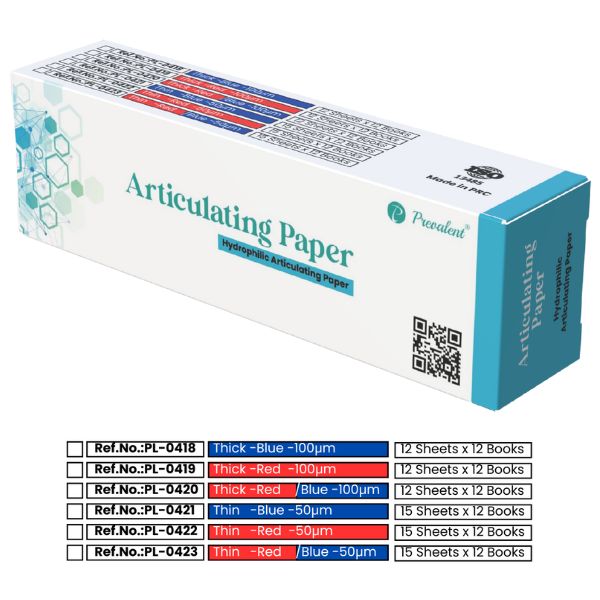
Thick – 100 μm
PL-0418 – Thick – Blue – 100 μm – 12 Sheets × 12 Books
PL-0419 – Thick – Red – 100 μm – 12 Sheets × 12 Books
PL-0420 – Thick – Red/Blue – 100 μm – 12 Sheets × 12 Books
Thin – 50 μm
PL-0421 – Thin – Blue – 50 μm – 15 Sheets × 12 Books
PL-0422 – Thin – Red – 50 μm – 15 Sheets × 12 Books
PL-0423 – Thin – Red/Blue – 50 μm – 15 Sheets × 12 Books
Reviews
There are no reviews yet.